What to Bring to the 2-Month Well-Child Visit
The 2-month well-child visit is the pediatrician checkup at about 8 weeks of age: your baby is weighed and measured, the doctor checks development and feeding, the first big round of vaccines is given, and you get time for questions. It is one of the visits on the American Academy of Pediatrics (AAP) schedule of well-child care (AAP).
The 2-month checkup is also often the first appointment where sleep deprivation and paperwork collide. Parents ask what to bring because they want to walk in prepared, not reconstruct eight weeks of feeds and diapers from memory while the baby cries.
What should you bring to the 2-month checkup?
Bring the diaper-bag basics, your insurance card and any forms, a written list of questions, your baby's vaccine record, and a one-page summary of the last few weeks of feeds, sleep, diapers and growth. In full:
- Diaper bag basics: diapers, wipes, a change of clothes, a feed if needed
- Insurance card and any forms the office sent ahead
- A short written list of questions (you will forget half of them otherwise)
- Vaccine record or visit history if you keep it yourself
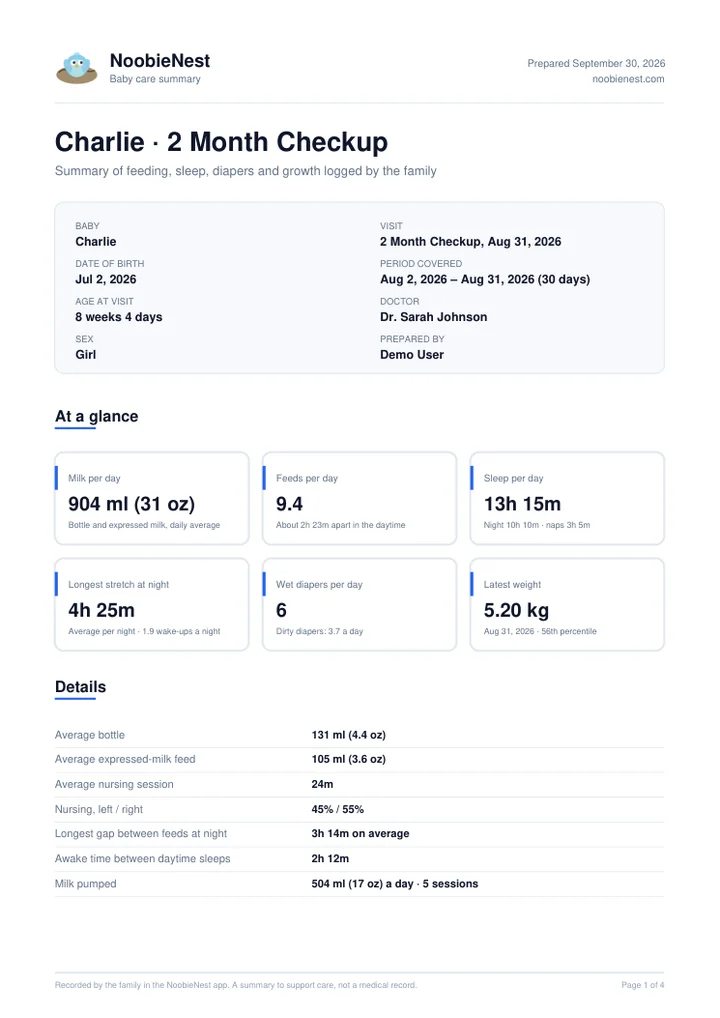
- A one-page summary of recent feeds, sleep, diapers, growth, and notes, printed or on your phone
- A blanket or light layer: babies are undressed for weighing and measuring
- A second adult if you can manage it, so one person can soothe while the other listens
What happens at the 2-month visit?
The AAP describes well-child visits as a check of growth, development, behavior, nutrition, sleep and safety, plus vaccines and time for your questions (HealthyChildren.org). At 2 months that usually means:
- Measurements: weight, length and head circumference, plotted on the growth chart. Ask for the percentiles and write them down; the trend across visits is what matters (see growth percentiles explained).
- Development check: head control when held upright, following a face or object with the eyes, first social smiles, cooing. Milestone questions are easier if you have noted the date of the first smile instead of guessing.
- Feeding and diapers: how often, how much, how many wet and dirty diapers, any spit-up or fussiness.
- Sleep: where and how your baby sleeps (back, own sleep surface, no loose bedding), and roughly how long the night stretches are.
- Vaccines: the 2-month doses on the CDC schedule, usually given at the end of the visit.
Which vaccines are given at 2 months?
The CDC and AAP schedule lists these for the 2-month visit: DTaP (diphtheria, tetanus, pertussis), Hib, polio (IPV), pneumococcal (PCV), rotavirus (given by mouth), and the second hepatitis B dose if the first was given at birth (CDC, AAP). Some offices use combination shots, so the number of injections varies. Your pediatrician may also discuss RSV protection depending on the season and what your baby received at birth.
Common after-effects are a sore leg, fussiness and a low fever for a day or two. Ask the office what dose of infant acetaminophen is right for your baby's weight before you leave, so you are not searching for it at midnight. Call if there is a fever over 100.4°F (38°C) in a baby this young and you are unsure, or anything that worries you.
What questions should you ask at the 2-month visit?
Ask about anything you have wondered at 3 a.m.; there is no silly question at this visit. Starting points:
- Is weight gain on track for our baby?
- How many wet diapers should we still expect?
- What sleep patterns are normal at this age, and is our sleep setup safe?
- Which vaccines today, and what side effects should we watch for?
- Is this much spit-up normal? What about the hiccups, sneezing, or rashes?
- When does the next visit happen, and what will it cover?
- Anything we should change about feeding, or plan for solids later?
Bring numbers, not vibes
“Feeds seem fine” is hard for a clinician to work with. “About seven feeds a day, roughly 3–4 oz each, five to six wet diapers, longest night stretch about four hours” is useful. That is what a doctor-ready report is for.
NoobieNest rolls daily feed, sleep, and diaper summaries, growth with percentiles, vaccine history, and your notes into one PDF you can email before the visit or print and bring. See a sample doctor report.
When is the next checkup?
After the 2-month visit, the AAP schedule has well-child visits at 4, 6, 9, 12, 15, 18 and 24 months, then yearly from age 3 (AAP periodicity schedule). Book the 4-month visit before you leave; those slots fill up, and the next round of vaccines is due then.
Day-of tip
Arrive a few minutes early, keep the question list on your lock screen, and hand the report to the nurse or doctor when they ask how things have been. Feed your baby before the vaccines if the timing works; a full, calm baby usually settles faster afterward. You are not expected to remember every Tuesday diaper from memory.
Related reading
Sources
- American Academy of Pediatrics (HealthyChildren.org): Well-Child Care: A Check-Up for Success
- American Academy of Pediatrics: Recommendations for Preventive Pediatric Health Care (periodicity schedule)
- American Academy of Pediatrics (HealthyChildren.org): Recommended Immunization Schedules
- Centers for Disease Control and Prevention (CDC): Child and Adolescent Immunization Schedule
NoobieNest articles are for general information only and are not medical advice. Ask your pediatrician about what is right for your baby.