Newborn Feeding Amounts: What to Expect in the First Weeks
Newborn feeding amounts are about half an ounce (15 ml) per feed on days 1 and 2, then 1 to 2 ounces (30 to 60 ml), rising to 3 to 4 ounces (90 to 120 ml) about every 3 to 4 hours by the end of the first month, according to the American Academy of Pediatrics (AAP).
In the first weeks, feeding can feel like the whole job. Parents search for “how many ounces should a newborn eat” because every feed feels high-stakes, especially at 3 a.m. Here are the ranges the AAP and the CDC publish, what they do and do not tell you, and a simple way to keep a feed log your pediatrician can actually use.
How much should a newborn eat per feed?
Most newborns take 1 to 2 ounces per feed after the first day or two, and at least 3 to 4 ounces per feed by the end of the first month. The AAP's published ranges (HealthyChildren.org):
- Days 1–2: babies may take only about half an ounce (15 ml) per feed. A newborn's stomach is tiny and milk supply is still coming in.
- After the first day or two: usually 1 to 2 ounces (30 to 60 ml) at each feed.
- By the end of month 1: at least 3 to 4 ounces (90 to 120 ml) per feed, about every 3 to 4 hours.
- By 6 months: 6 to 8 ounces (180 to 240 ml) at each of 4 or 5 feeds in 24 hours.
For formula, the AAP also gives a weight rule of thumb: about 2½ ounces (75 ml) per day for every pound of body weight, and usually no more than about 32 ounces (960 ml) in 24 hours (AAP). An 8-pound baby would land near 20 ounces a day; a 10-pound baby near 25. These are averages across a day, not a target for every bottle.
Two limits worth knowing. First, the ranges are wide on purpose: a baby who takes 2 ounces at one feed and 4 at the next is normal. Second, the number on the bottle matters less than the trend over days: steady weight gain and enough wet diapers are the real checks (see how many wet diapers a newborn should have).
How often should a newborn eat?
Breastfed newborns usually nurse about every 2 hours, counted from the start of one feed to the start of the next, which works out to 10 to 12 sessions in 24 hours. Bottle-fed newborns usually eat every 2 to 3 hours, with 8 feeds a day the usual minimum (AAP). The CDC describes the same picture for the first weeks: 8 to 12 breastfeeds in 24 hours, and more during a growth spurt (CDC).
“Every 2 hours” sounds manageable until you do the arithmetic: a 40-minute feed every 2 hours leaves 80 minutes between feeds, around the clock. That arithmetic is why the early weeks feel like one long feed. The gap between feeds gets longer as the per-feed amount grows.
Some evenings, a baby wants to feed every 30 to 60 minutes for a few hours. The pattern is called cluster feeding, and cluster feeding is usually normal. Our guide to cluster feeding covers when it happens and how to tell it apart from a feeding problem.
Nursing: how do you know it is enough?
You cannot see ounces when you breastfeed, so the useful numbers are feeds per day, wet and dirty diapers, and weight checks at the pediatrician. The AAP lists warning signs that mean a feed is not going well, including fewer than 6 wet diapers a day after the first week and a baby who is still losing weight after day 5 (AAP). If you see those, call the office rather than waiting for the next scheduled visit.
For a nursed baby, what helps most at a visit is how often feeds happened, roughly how long each nursing session lasted, and whether both sides were offered. A calm log of start times beats guessing from memory in the exam room.
What should you write down at 3 a.m.?
Four things: the time the feed started, bottle or breast, the amount (bottle) or the side and rough minutes (breast), and anything unusual. That is all. A feed log does not need notes on every burp. Over a week it adds up to the numbers below without you ever opening a spreadsheet.
- Feeds per 24 hours, and the longest gap between feeds
- Average amount per bottle, and total milk per day
- Nursing minutes per side, if you track nursing time
- Spit-up, fussiness around feeds, or a feed refused
What will the pediatrician ask?
- How many feeds in 24 hours?
- Rough amount per bottle, or minutes per nursing session?
- How many wet and dirty diapers?
- Any spit-up, fussiness around feeds, or long gaps?
- Is your baby back to birth weight (usually by about 2 weeks)?
You do not need a perfect spreadsheet. You need a clear weekly picture: average milk per day, feed count, and notes worth mentioning. Our 2-month checkup checklist shows what that looks like on paper.
When should you worry about amounts?
Call your pediatrician the same day if your newborn refuses two feeds in a row, is too sleepy to wake for feeds, has fewer wet diapers than expected for the baby's age, or vomits forcefully after feeds. Spit-up that dribbles out is common; a baby who is losing weight is not. Everything else, from a bottle left half-finished to a day of extra-hungry feeds, is usually just a newborn being a newborn.
Log feeds in seconds
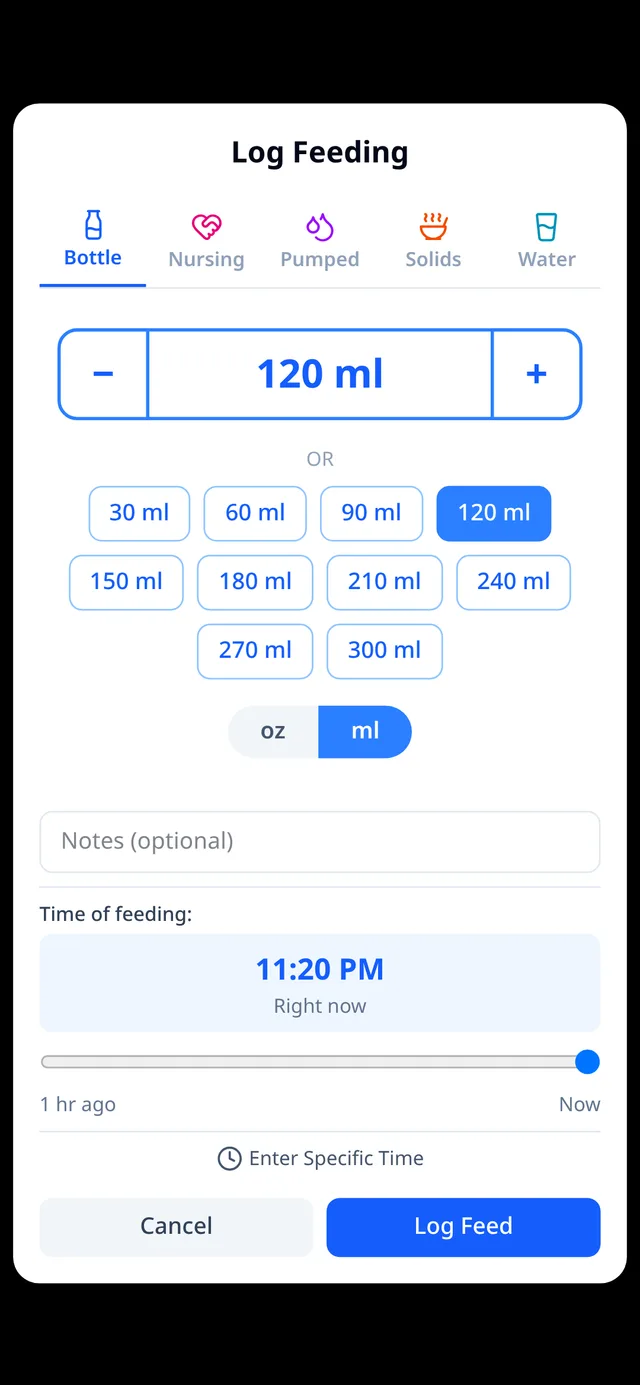
Most baby apps turn a bottle into a multi-screen chore. NoobieNest is built for one-handed logging: tap feed, set amount if you want, done. Before a well-child visit, you can make a doctor-ready PDF with daily feed summaries instead of reconstructing the last month from texts and sticky notes.
Related reading
Sources
- American Academy of Pediatrics (HealthyChildren.org): How Often and How Much Should Your Baby Eat?
- American Academy of Pediatrics (HealthyChildren.org): Amount and Schedule of Baby Formula Feedings
- Centers for Disease Control and Prevention (CDC): How Much and How Often to Breastfeed
- American Academy of Pediatrics (HealthyChildren.org): Warning Signs of Breastfeeding Problems
NoobieNest articles are for general information only and are not medical advice. Ask your pediatrician about what is right for your baby.