How Many Wet Diapers Should a Newborn Have? A Day-by-Day Guide
A newborn's wet diaper count is the number of urine-wet diapers in 24 hours, and it is the simplest home check that a baby is getting enough milk: about one wet diaper per day of age for the first few days, then at least 6 a day from about day 5 onward, with pale urine.
In the first week, it is hard to know whether your baby is getting enough. You cannot see ounces when you nurse, bottle amounts change daily, and everyone has an opinion. Diapers are one of the few things you can actually count. That is why nurses and pediatricians ask about them at nearly every early visit.
Here is what the American Academy of Pediatrics (AAP) and the CDC say to look for, day by day, and the signs that mean it is time to call your pediatrician rather than wait for the next checkup.
How many wet diapers should a newborn have?
By about day 5, most guidance points to at least 6 wet diapers in 24 hours, with pale or nearly clear urine. Before that, fewer wet diapers are expected because the amount of milk your baby is taking in is still small.
- The AAP says a well-nourished breastfed newborn should have 6 or more wet diapers per day, with nearly colorless or pale yellow urine, by 5 to 7 days old (AAP, HealthyChildren.org).
- A separate AAP feeding article puts it as 2 to 3 wet diapers a day in the first few days, then at least 5 to 6 a day after the first 4 to 5 days (AAP, HealthyChildren.org).
- The CDC lists fewer than 6 pees and fewer than 3 poops per day by 5 days old as a sign your baby might not be getting enough to eat (CDC).
The sources word it a little differently, but the picture is the same: a slow start in the first couple of days, then a clear step up once milk comes in.
How many wet diapers per day in the first week?
At least 1 on day 1, 2 on day 2, 5 on day 3, and 6 a day from day 4 on, for a breastfed baby. The CDC publishes a simple table of the minimum number of wet diapers and poops to look for in a breastfed baby's first week (adapted from the USDA WIC program) (CDC):
| Baby's age | Wet diapers (at least) | Poops (at least) |
|---|---|---|
| Day 1 | 1 | 1 |
| Day 2 | 2 | 3 |
| Day 3 | 5 | 3 |
| Day 4 | 6 | 3 |
| Days 5 to 7 | 6 | 3 |
Other sources describe a slightly slower ramp. Nemours KidsHealth notes that because colostrum is concentrated, a baby may have only one or two wet diapers in the first 24 hours (Nemours KidsHealth). For stools, the AAP describes black, tarry bowel movements on days 1 and 2, then stools that start to turn greenish to yellow on days 3 and 4, and by 5 to 7 days, yellow, loose stools with small curds, at least 3 to 4 a day (AAP).
Your baby's nurse or pediatrician may give you a slightly different target, especially if your baby was born early or had a rocky start with feeding. Their guidance comes first.
What about dirty diapers?
Poop varies more than pee, and it depends on whether your baby gets breast milk, formula, or both (AAP). The CDC notes that stool from a breastfed baby usually changes from black or dark green to yellow during the first week. After that, it is often yellow and seedy, and from the first week up to about 6 weeks, some babies have 6 or more poops a day. After about 6 weeks, many babies poop less often (CDC).
Formula-fed babies often have fewer, firmer stools. If you are unsure what is normal for your baby, your pediatrician can tell you what pattern to expect.
Wet diapers are one clue, not the whole picture
Diaper counts are useful because they are easy to see. Pediatricians look at them alongside other signs. The AAP and CDC mention:
- Weight. It is normal for newborns to lose some weight after birth. The AAP says no more than 8 to 10 percent of birth weight in the first few days (AAP), and the CDC says breastfed babies should be back to birth weight by day 10 to 14 (CDC).
- Feeding frequency. About 8 to 12 feeds in 24 hours for breastfed newborns (CDC).
- Swallowing and contentment. Being able to see or hear your baby swallow, and your baby seeming content after a feed.
If you want the bigger feeding picture, our guide to newborn feeding amounts covers typical bottle volumes and nursing frequency. If your baby seems to want to feed every hour in the evening, see cluster feeding.
When should you call the pediatrician about diapers?
Call the same day if your baby has fewer than 6 wet diapers a day after the first week, dark urine, or no stool for a day in the first weeks. The AAP lists these as warning signs worth a call, not a wait-and-see (AAP):
- After 7 days, fewer than 6 wet diapers and 4 stools a day.
- Urine that is dark yellow or specked with red.
- Stools that are still dark rather than yellow and loose after the first week.
The AAP also lists signs of dehydration in babies, including fewer than six wet diapers a day, a dry mouth, fewer tears when crying, and a sunken soft spot on the head. It advises calling the pediatrician right away if any of these show up (AAP). Nemours KidsHealth adds that if you see orange crystals in a wet diaper, call your baby's doctor. They are often harmless, but sometimes a sign a baby is not getting enough fluid (Nemours KidsHealth).
If your baby seems very sleepy and hard to wake for feeds, is unusually fussy, or just does not seem right to you, call. You do not need a diaper count to trust your instincts.
Tips for counting at 3 a.m.
- Modern diapers hide pee well. Many disposables have a wetness indicator stripe. If yours do not, it can help to hold a dry diaper and a used one to compare the weight.
- Count over 24 hours, not per feed. A single dry stretch is less informative than the total for the day.
- Write it down as you go. The AAP suggests keeping a written record of wet diapers and bowel movements in the early days if you or your pediatrician are concerned about intake (AAP). Memory is unreliable when you are this tired.
- Note anything unusual. Dark urine, a change in stool color, or a long gap. A short note now saves trying to remember later.
Keeping a diaper log without the hassle
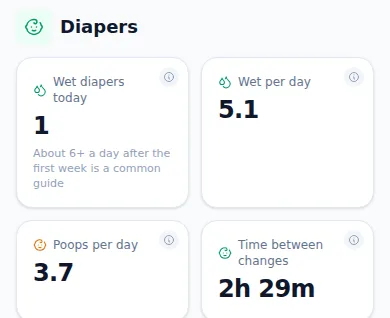
Hospitals often hand out a paper chart for the first few days. It works until it ends up under a burp cloth. NoobieNest lets you log a wet, dirty, or both diaper in one tap. The Today screen shows how many wet and dirty diapers you have logged so far and how long it has been since the last one, so you can answer “how many today?” at a glance.
Before a weight check or well-child visit, you can create a doctor-ready report with daily diaper, feed, and sleep summaries. Here is a sample report so you can see what your pediatrician would get. It costs $4.99 a month or $39.99 a year after a 14-day free trial, with no card needed to start.
Related reading
Sources
- American Academy of Pediatrics (HealthyChildren.org): How to Tell if Your Breastfed Baby is Getting Enough Milk
- American Academy of Pediatrics (HealthyChildren.org): How Often and How Much Should Your Baby Eat?
- American Academy of Pediatrics (HealthyChildren.org): Warning Signs of Breastfeeding Problems
- American Academy of Pediatrics (HealthyChildren.org): Signs of Dehydration in Infants & Children
- Centers for Disease Control and Prevention (CDC): Newborn Breastfeeding Basics
- Nemours KidsHealth: Breastfeeding FAQs: Getting Started
NoobieNest articles are for general information only and are not medical advice. Ask your pediatrician about what is right for your baby.