Baby Sleep by Age: Totals and Patterns from Newborn to 12 Months
Baby sleep by age is the typical total sleep in 24 hours, naps included: about 14 to 17 hours for newborns up to 3 months (National Sleep Foundation), and 12 to 16 hours from 4 to 12 months (American Academy of Sleep Medicine, endorsed by the American Academy of Pediatrics).
“How much should my baby sleep?” is one of the most searched new-parent questions, usually at night. Charts help with expectations. Your baby's actual pattern still wins. Here are the published ranges, what they do and do not mean, and a calm way to track sleep without coaching apps or guilt alerts.
How much sleep does a baby need at each age?
Newborns need roughly 14 to 17 hours a day, babies from 4 to 12 months 12 to 16 hours, and toddlers from 1 to 2 years 11 to 14 hours, all counted over 24 hours and including naps. The two main published sources agree closely:
Ranges vary widely. Use these as ballparks, not grades.
| Age | Total sleep / 24h | Source | What it often looks like |
|---|---|---|---|
| 0–3 months | 14–17 hours | NSF (AASM gives no range under 4 months) | Short stretches of 2–4 hours, many night feeds, day and night still sorting out |
| 4–11 months | 12–16 hours (AASM) · 12–15 hours (NSF) | AASM, NSF | Longer night stretches for some; 2–3 naps common |
| 12–24 months | 11–14 hours | AASM, NSF | Often 2 naps, then a drift toward 1 longer midday nap |
The AASM figures come from a 2016 consensus statement by a panel of 13 pediatric sleep experts, published in the Journal of Clinical Sleep Medicine (Paruthi et al.). The AAP endorses them and repeats them on its parent site (HealthyChildren.org). The newborn range comes from the National Sleep Foundation's 2015 panel (Hirshkowitz et al.), because the AASM panel decided there was not enough evidence to set a number for babies under 4 months.
How long should a newborn sleep at a stretch?
In the first weeks, usually 2 to 4 hours at a time, around the clock, because a newborn's stomach is small and feeds come every 2 to 3 hours (see newborn feeding amounts). Newborns also do not yet have a day-night rhythm; that develops over the first 2 to 3 months. Longer night stretches tend to appear gradually after that, but the age at which a baby first sleeps 5 or 6 hours in a row varies a lot and is not something you can schedule.
Two practical notes. First, ask your pediatrician whether to wake a sleepy newborn for feeds in the early weeks; the usual advice is to keep feeds coming until your baby is back to birth weight and gaining well. Second, a baby who sleeps a long stretch one night and wakes every 90 minutes the next is not regressing. That is what newborn sleep looks like.
How many naps does a baby take by age?
Newborns nap between feeds, often 4 or more times a day with no pattern. Many babies settle into 3 or 4 naps around 4 to 6 months, 2 naps somewhere in the second half of the first year, and 1 midday nap at some point between 12 and 18 months. These are common patterns parents and clinicians describe, not rules; the published ranges above are for total sleep, not nap counts.
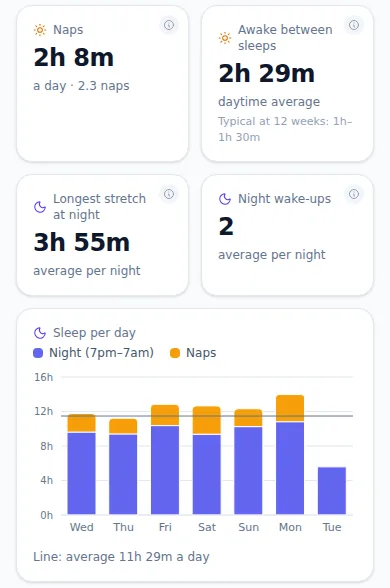
A sleep log shows what a sleep chart cannot: your baby's own pattern. After two weeks of one-tap sleep logging you can see the usual length of the morning nap, the time the longest night stretch tends to start, and whether a rough day was an outlier or a trend. That is more useful at a checkup than “sleep is okay, I think”.
What if your baby sleeps less than the range?
Usually nothing is wrong. Normal is a wide band, and the ranges above are population ranges, not targets for one baby on one day. A baby who sleeps 11 hours total one week and 15 the next is not failing a test. Illness, growth spurts, teething, travel, a developmental leap, and a stuffy nose all scramble the chart for days at a time.
Worth a call to your pediatrician: a baby who is hard to wake or unusually sleepy and feeding poorly, loud snoring or pauses in breathing during sleep, or sleep totals far below the range for weeks along with poor weight gain. Those are about the baby, not the chart.
Where should a baby sleep?
A baby should sleep on the back, on a firm, flat surface with only a fitted sheet, in the baby's own crib or bassinet, ideally in your room for at least the first 6 months. No pillows, blankets, bumpers or soft toys, and no sleeping on a couch or armchair with an adult. That is the AAP's safe sleep guidance in one paragraph; the full version is on HealthyChildren.org. It matters more than any total.
Track sleep without the guilt
NoobieNest does not coach sleep or send “you're behind” notifications. It shows what actually happened:
- Start sleep with one tap. End it with another.
- See today's total and the longest stretch at a glance.
- Overnight sleep is split correctly between the two calendar days.
- Before a well-child visit, include sleep summaries in the doctor-ready PDF.
If your pediatrician asks how nights are going, bring the last two weeks of totals, not a story you try to invent in the parking lot. Our 2-month checkup checklist has the rest of what to bring.
Related reading
Sources
- American Academy of Sleep Medicine (Paruthi et al., J Clin Sleep Med, 2016): Recommended Amount of Sleep for Pediatric Populations: A Consensus Statement
- National Sleep Foundation (Hirshkowitz et al., Sleep Health, 2015): National Sleep Foundation's sleep time duration recommendations
- American Academy of Pediatrics (HealthyChildren.org): Healthy Sleep Habits: How Many Hours Does Your Child Need?
- American Academy of Pediatrics (HealthyChildren.org): A Parent's Guide to Safe Sleep
NoobieNest articles are for general information only and are not medical advice. Ask your pediatrician about what is right for your baby.