Cluster Feeding: Why Your Newborn Wants to Eat Constantly (and How to Cope)
Cluster feeding is a stretch of a few hours, often in the evening, when a newborn wants to feed every 20 to 60 minutes instead of every 2 to 3 hours. Cluster feeding is common in the first weeks and is usually not a sign that anything is wrong with the baby, the latch or your milk supply.
At 7 p.m. your baby fed an hour ago and is rooting again. Then again. By 10 p.m. it feels like you have not put the baby down all evening, and you start to wonder whether something is wrong with your supply, the latch, or you.
Often, nothing is wrong: an evening of back-to-back feeds is cluster feeding. Below: what cluster feeding is, when cluster feeding tends to show up, how to tell it apart from a feeding problem, and a few things that make those evenings easier to get through.
What is cluster feeding?
Cluster feeding is when a baby bunches several feeds close together, usually for a few hours at a time, instead of spacing them out. The USDA's WIC Breastfeeding Support program describes it as feedings bunched together, especially in the evening, and says some babies may want to nurse every 30 minutes to an hour in the evenings. It also says plainly that this is normal and does not mean your baby is not getting enough milk (USDA WIC).
The CDC says most exclusively breastfed babies feed every 2 to 4 hours on average, about 8 to 12 times in 24 hours, and that some babies may feed as often as every hour at times, which is often called cluster feeding (CDC). The AAP notes that breastfed newborns commonly nurse about every 2 hours, and that 10 to 12 sessions in 24 hours is the norm (AAP).
A baby who feeds very often for part of the day, then sleeps a longer stretch, is usually still within the expected range.
When does cluster feeding happen?
Cluster feeding happens most often in the first days after birth, in the late afternoon and evening, and around growth spurts.
- The first days after birth. Frequent feeding helps build milk supply and gives your baby practice at sucking and swallowing (CDC).
- Evenings. Many parents notice it in the late afternoon and evening. WIC suggests it may be your baby's way of filling up before a longer sleep (USDA WIC). Cleveland Clinic notes that prolactin, the hormone behind milk production, naturally tends to be lower later in the day, which may play a part (Cleveland Clinic).
- Growth spurts. WIC says growth spurts typically happen around 2 to 3 weeks, 6 weeks, 3 months, and 6 months, usually last a few days, and can mean feeding longer and more often. It also says they may not happen at those exact times, and every baby is different (USDA WIC).
- Comfort. Babies feed for closeness and soothing too, not only hunger (Cleveland Clinic).
Cluster feeding or a feeding problem?
Telling the two apart is the question that keeps parents up. A cluster-feeding baby usually still has plenty of wet and dirty diapers, gains weight as expected at checkups, and has calmer stretches at other times of day. A feeding problem tends to show up across the whole day, not just one evening window.
The AAP lists these as reasons to check in with your pediatrician (AAP):
- Your baby still seems hungry after most feedings, not just during an evening cluster.
- Nursing sessions that are consistently longer than about 50 minutes, which can point to ineffective sucking or low supply.
- You do not hear frequent swallowing once your milk has come in.
- After 7 days, fewer than 6 wet diapers and 4 stools a day, or dark urine.
Diaper output is one of the easiest things to check. Our guide to how many wet diapers a newborn should have walks through the first week day by day. If you are also wondering about typical bottle volumes, see newborn feeding amounts.
If your baby seems unwell, is hard to wake, or you just have a feeling something is off, call your pediatrician. You do not need to be sure first.
What about bottle-fed babies?
Most of the published guidance on cluster feeding is about breastfeeding, but bottle-fed babies have hungrier stretches too. The AAP encourages feeding healthy, full-term babies when they show hunger cues rather than strictly by the clock, an approach it calls responsive feeding (AAP). If your formula-fed baby wants frequent bottles for days and you are unsure about amounts, ask your pediatrician rather than guessing.
How to get through cluster-feeding evenings
Cluster feeding stays tiring, but these five habits make the long evenings more manageable.
- Set up a feeding spot before evening starts. Water, a snack, your phone charger, burp cloths, and the remote within reach. WIC notes you may feel hungrier and thirstier while nursing (USDA WIC).
- Hand off everything else. WIC suggests asking your partner and family for extra help in the evenings (USDA WIC). Dinner, diapers, dishes, older kids: anything that is not feeding can go to someone else.
- Plan sleep around it. If evenings are a marathon, try to rest earlier in the day or take the first stretch of sleep after the cluster ends.
- Follow your baby's lead. WIC's advice during growth spurts is to keep feeding on cue, because your body adjusts to make the amount your baby needs (USDA WIC).
- Lean on a lactation consultant. If feeds hurt, the latch keeps slipping, or you are worried about supply, a lactation consultant or your pediatrician can watch a feed and help in a way an article cannot.
Why logging helps here
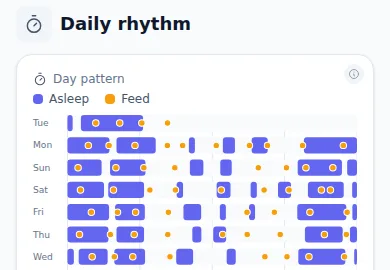
In the middle of a cluster, the feeds blur together. A simple feed log helps you see the pattern: is it every evening from 6 to 10, or all day? Did it start around the 3-week mark and settle after a few days? Feed timing like that is exactly the detail your pediatrician will ask about.
NoobieNest is built for one-handed logging. A nursing session or bottle takes a couple of taps, and the Today screen shows feeds so far, the time since the last one, and the average gap between feeds. Diapers work the same way. Before a well-child visit, you can turn it into a doctor-ready report so you are not trying to recall a blurry week from memory. Take a look at a sample report, or check pricing: a 14-day free trial with no card, then $4.99 a month or $39.99 a year.
Cluster feeding usually passes. Until it does, be gentle with yourself. A baby who wants to feed a lot is not a sign that you are doing it wrong.
Related reading
Sources
- Centers for Disease Control and Prevention (CDC): How Much and How Often to Breastfeed
- USDA WIC Breastfeeding Support: Cluster Feeding and Growth Spurts
- American Academy of Pediatrics (HealthyChildren.org): How Often and How Much Should Your Baby Eat?
- American Academy of Pediatrics (HealthyChildren.org): Warning Signs of Breastfeeding Problems
- Cleveland Clinic: What Is Cluster Feeding?
NoobieNest articles are for general information only and are not medical advice. Ask your pediatrician about what is right for your baby.